
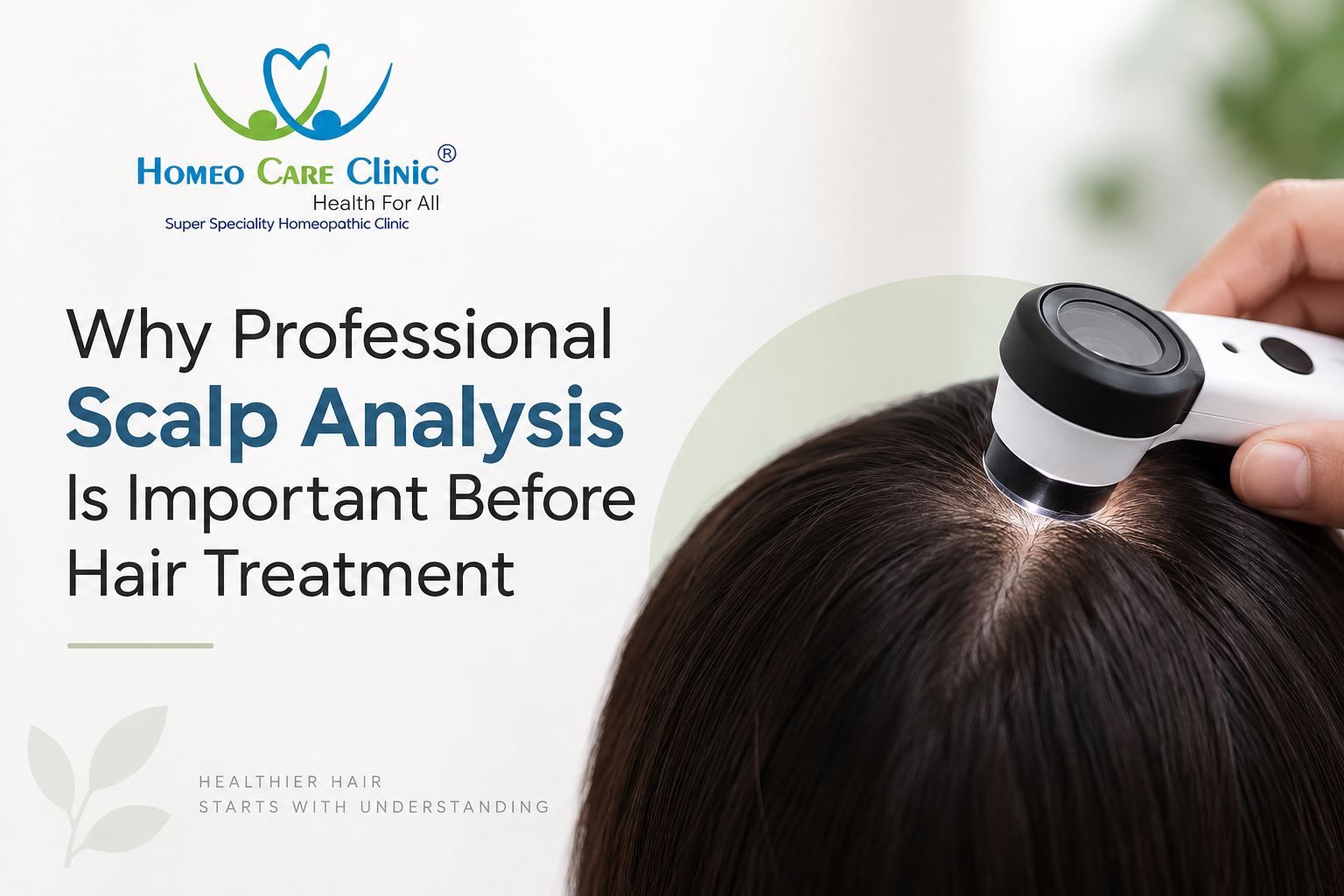
Hair fall, thinning, dandruff, an itchy scalp, or a receding hairline can be frustrating. But before choosing a hair treatment, there is one important step that is often overlooked: professional scalp analysis.
Your scalp is the foundation of healthy hair growth. Just like you would not treat a health problem without understanding its cause, hair treatment should ideally begin with understanding what is happening on your scalp and around your hair follicles.
A professional scalp analysis can help identify visible scalp concerns, assess hair and follicle condition, and guide a more personalised approach to hair care.
At Hair Prp Treatement
hair concerns are assessed as part of an individualised consultation, taking into account symptoms, health history, lifestyle and other relevant factors. The clinic also lists trichoscopy and skin/scalp analysis among the procedures in which Dr. Vaseem Choudhary has received training.
What Is a Professional Scalp Analysis?
A professional scalp analysis is an assessment of the scalp and hair that helps a qualified professional understand the condition of your scalp and identify factors that may be contributing to your hair concerns.
Depending on the individual’s symptoms and clinical needs, an assessment may look at areas such as:
- Scalp dryness or excessive oiliness
- Dandruff and flaking
- Redness or signs of irritation
- Hair density and visible thinning
- Hair shaft condition
- Scalp inflammation
- Distribution and pattern of hair loss
- Overall scalp and follicle appearance
In some cases, a specialist may use trichoscopy, a magnified examination of the scalp and hair, to obtain a closer view of features that may not be easy to see with the naked eye.
Why Should Scalp Analysis Come Before Hair Treatment?
One of the biggest mistakes people make is choosing a treatment simply because it worked for someone else.
Hair loss does not have one single cause. Hair fall and thinning can be associated with factors such as genetics, hormonal changes, nutritional issues, stress, scalp conditions, illness, medications, or other underlying factors.
That means the same treatment may not be appropriate for everyone.
A professional scalp assessment provides a better starting point for understanding your individual situation.
1. It Helps Identify Your Scalp Condition
A scalp can look relatively normal while still having issues that require attention.
Excess oil, dryness, flaking, irritation or inflammation can affect scalp comfort and may contribute to hair-related concerns.
A professional assessment can help distinguish between different scalp concerns instead of treating every case as ordinary hair fall.
2. It Helps Understand Your Hair Loss Pattern
Not all hair loss looks the same.
Some people experience gradual thinning, while others notice increased shedding or hair loss in specific areas. Hair loss may also affect men and women differently.
Understanding the pattern, distribution and progression of hair loss can help a professional determine what should be investigated further.
3. It Supports Personalised Hair Treatment
There is no universal solution for hair problems.
Your age, medical history, lifestyle, scalp condition, hair-loss pattern and other individual factors may all influence the appropriate approach.
This is why personalised assessment is important before deciding on a treatment plan.
Hair Prp Treatment states that its doctors consider the patient’s symptoms, medical history, lifestyle and individual health concerns when developing personalised care.
4. It Can Prevent Unnecessary Treatments
Trying multiple hair products or treatments without understanding the underlying problem can be frustrating and expensive.
For example, someone experiencing excessive shedding may assume they simply need a hair-growth product, while another person may primarily need assessment of an underlying scalp condition.
A professional evaluation helps move the conversation from “What product should I use?” to “What is actually causing my hair concern?”
5. It Creates a Baseline for Monitoring Progress
A detailed initial assessment can provide a useful reference point.
As treatment continues, changes in hair density, scalp condition, shedding or other relevant features can be monitored over time.
This makes it easier to evaluate whether the chosen approach is helping and whether further assessment may be necessary.
What Can a Scalp Analysis Help Detect?
A professional assessment may help identify or evaluate concerns such as:
- Hair thinning
- Excessive hair shedding
- Dandruff
- Dry or oily scalp
- Scalp irritation
- Patchy hair loss
- Male-pattern hair loss
- Female-pattern hair loss
- Alopecia-related concerns
- Changes in hair density
- Other scalp or hair abnormalities
However, scalp analysis is not always enough to determine the cause by itself. Depending on your symptoms, a healthcare professional may recommend additional examination, medical history review or appropriate investigations.
Scalp Analysis vs. Looking at Your Hair in the Mirror
It is easy to notice that your hair is becoming thinner. What is much harder is understanding why.
Looking in the mirror may tell you that your hairline has changed or that your scalp is becoming more visible. A professional assessment can provide a more structured evaluation of the scalp, hair and pattern of hair loss.
Think of it this way:
Visible symptom → Professional assessment → Possible cause → Personalised treatment approach
This approach is generally more useful than jumping straight from symptom to treatment.
When Should You Consider a Professional Scalp Assessment?
Consider speaking with a qualified healthcare professional if you notice:
- Hair fall that is persistent or increasing
- Noticeable thinning
- A widening hair part
- Receding hairline
- Visible scalp in areas where it was previously less noticeable
- Sudden or unusual shedding
- Patchy areas of hair loss
- Persistent dandruff or scalp irritation
- Changes in scalp condition along with hair loss
Sudden or significant hair loss deserves professional evaluation because different causes can require different approaches.
What Happens During a Professional Hair and Scalp Consultation?
A consultation generally begins with understanding your concerns.
A professional may ask about:
- When your hair fall or thinning started
- Whether the problem is getting worse
- Family history of hair loss
- Recent illness or major stress
- Diet and lifestyle
- Existing health conditions
- Medicines or supplements
- Scalp symptoms such as itching or flaking
- Previous hair treatments
The scalp and hair may then be examined, and tools such as trichoscopy may be considered when clinically appropriate.
The goal is not simply to look at your hair. It is to build a clearer picture of your hair and scalp health before deciding on the next step.
Why Personalised Assessment Matters
Imagine two people experiencing hair fall.
One may have gradual thinning related to genetic factors. Another may have increased shedding following a stressful period or illness. Someone else may have a scalp condition contributing to their symptoms.
All three may describe their problem as simply “hair fall.”
But the underlying situation may be very different.
That is why professional scalp analysis and a detailed consultation can be valuable before starting hair treatment.
Professional Scalp Analysis at Hair Prp Treatment
At Hair Prp Treatment , the approach to hair concerns focuses on understanding the individual rather than treating a symptom in isolation.
The clinic offers care for a range of hair concerns, including hair fall, hair thinning, dandruff, alopecia areata, male and female baldness, post-COVID hair fall and patchy hair loss. It also lists hair-growth procedures and treatments including PRP, GFC, laser hair growth treatment and other hair-related services.
Dr. Vaseem Choudhary’s profile on the clinic website notes training in procedures including skin analysis scanning and trichoscopy, along with additional dermatology and aesthetic procedures.
The important point is that treatment should begin with understanding the person’s individual concern and clinical situation rather than assuming that one solution works for everyone.
Frequently Asked Questions
Is scalp analysis necessary before hair treatment?
It can be very helpful, particularly when the cause of hair fall or thinning is unclear. A professional assessment helps evaluate the scalp and hair and can guide decisions about whether further investigation or treatment is appropriate.
Does scalp analysis help with hair fall?
Scalp analysis can provide useful information about the condition of the scalp and the pattern of hair changes. However, the underlying cause of hair loss may require a broader medical assessment.
What is trichoscopy?
Trichoscopy is a non-invasive examination technique that uses magnification to assess the scalp and hair. It can help professionals examine features that may not be clearly visible during a routine visual examination.
Can one hair treatment work for everyone?
Not necessarily. Hair loss can have different causes and patterns, so treatment should ideally be selected according to the individual’s symptoms, clinical findings and overall health situation.
When should I see a professional for hair loss?
If hair loss is persistent, worsening, sudden, patchy, or accompanied by scalp symptoms such as significant itching, redness or scaling, it is sensible to seek professional medical advice.